
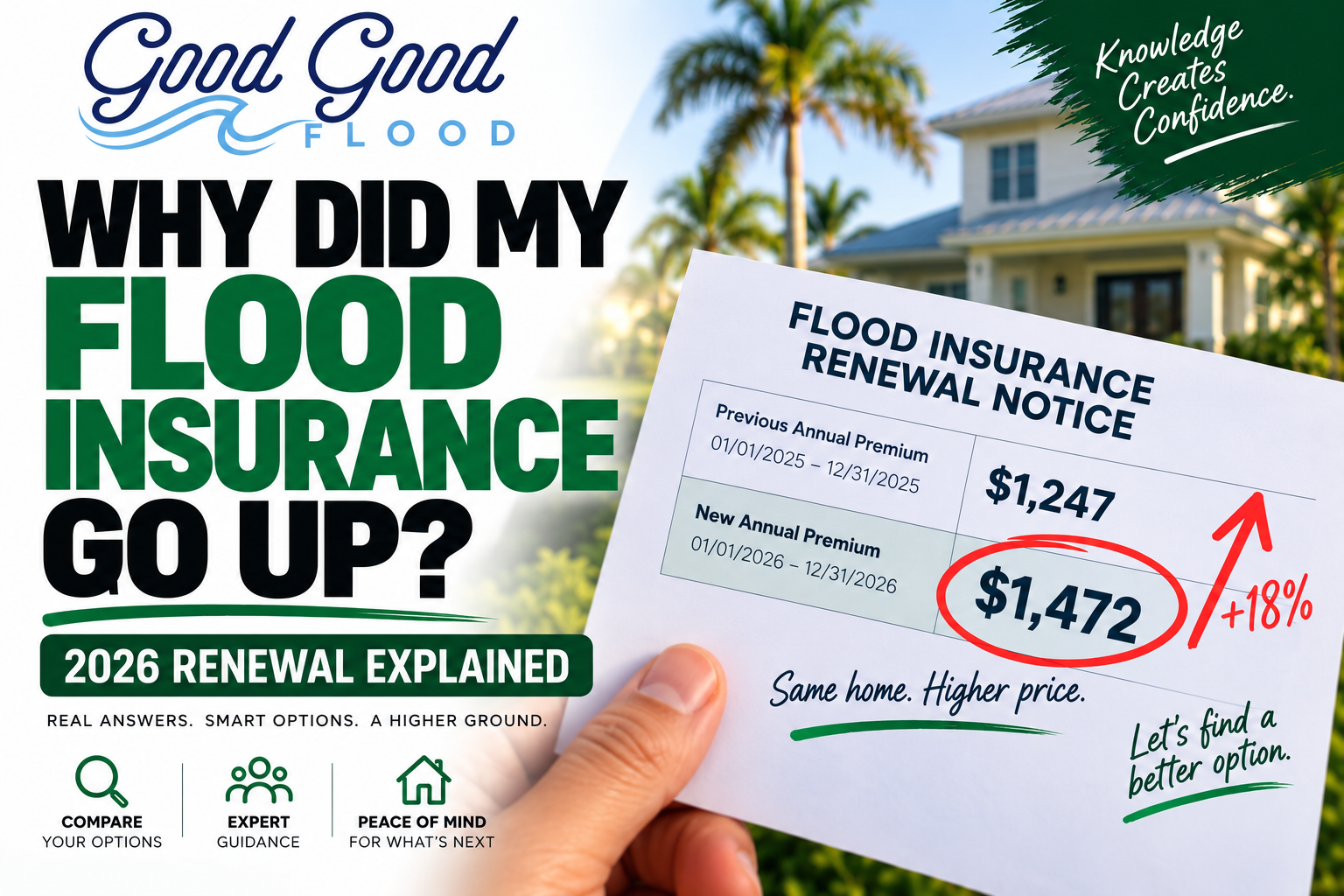
You open your flood insurance renewal expecting roughly the same premium as last year.
Instead, it went up.
Again.
Maybe it increased by a couple hundred dollars. Maybe it jumped significantly more. Either way, the first question is usually the same:
“Why did my flood insurance go up when nothing about my house changed?”
You’re not alone.
At Good Good Flood, we work with flood insurance every day, and rising renewal premiums are one of the biggest frustrations we hear from homeowners.
The good news? Your renewal price isn’t necessarily your only option.
Before automatically paying your renewal—or canceling your policy out of frustration—it’s worth understanding why the price changed and whether another flood insurance option may make more sense.
Here are seven reasons your flood insurance premium may have increased in 2026.
1. Your NFIP Policy May Still Be Moving Toward Its Full-Risk Premium
One of the biggest reasons some homeowners continue to see increases is FEMA’s Risk Rating 2.0 methodology.
Instead of relying primarily on flood zones and elevation, FEMA now uses additional property-specific factors when determining NFIP flood insurance pricing.
Those factors can include things such as:
Distance from potential flooding sources
Ground and first-floor elevation
Foundation type
Building characteristics
Replacement cost
Type of flooding that could affect the property
That means two houses in the same neighborhood—even houses located relatively close to one another—can potentially have very different flood insurance premiums.
For many existing NFIP policyholders, the transition to their property’s full-risk premium has been gradual rather than happening all at once.
So even if you haven’t filed a claim, moved, remodeled your house or changed your coverage, your NFIP renewal can still increase from one year to the next.
2. Your Property’s Flood Risk Matters More Than Just Your Flood Zone
One of the biggest misconceptions we hear is:
“I’m in Flood Zone X, so why is my flood insurance expensive?”
Your flood zone is important, especially when determining whether a lender may require flood insurance.
But your flood zone isn’t the only factor used to determine an NFIP premium under Risk Rating 2.0.
A property’s individual characteristics and proximity to flooding sources can affect its pricing.
That’s why simply asking:
“What flood zone am I in?”
doesn’t always tell you what your flood insurance should cost.
And it’s another reason comparing available flood insurance options can be worthwhile.
3. Your Coverage or Deductible May Have Changed
Sometimes the reason for an increase is much simpler.
Compare your new renewal with last year’s policy.
Did your building coverage increase?
Did your contents coverage change?
Did your deductible decrease?
Was other information about the property updated?
Changes to the policy itself can affect what you pay.
Before assuming the entire increase is simply a “rate increase,” review the declarations page and compare it with your previous policy.
At Good Good Flood, that’s one of the first things we look at when reviewing a client’s renewal.
4. Your Community’s Flood Insurance Discount Could Have Changed
Some communities participating in FEMA’s Community Rating System (CRS) qualify residents for NFIP premium discounts based on floodplain-management activities performed by the community.
If your community’s CRS classification changes, the discount associated with an NFIP policy can potentially change as well.
This isn’t something most homeowners are watching—and understandably so.
You shouldn’t need to become a flood insurance expert just to understand why your bill changed.
That’s what your flood insurance agent should be helping you figure out.
5. Fees, Surcharges and Other Policy Components Can Affect the Total Renewal
When comparing this year’s total bill with last year’s, remember that the final amount you pay isn’t necessarily just the underlying premium.
Fees and surcharges can also be part of the total.
FEMA has explained that most NFIP policies subject to Risk Rating 2.0 have a statutory annual premium increase cap of 18%, but certain fees and surcharges aren’t included within that cap.
Coverage changes, deductible changes and changes to certain discounts can also affect the total amount you see on your renewal.
So if your total bill appears to have increased dramatically, don’t just look at the final number.
Look at what actually changed.
6. Replacement Costs and Property Characteristics Matter
Flood insurance pricing has become much more property-specific.
FEMA’s methodology considers characteristics of the individual building, including factors associated with rebuilding costs.
This is important because flood risk isn’t identical from one property to another.
A $300,000 home and a $1.5 million home located in the same general area don’t necessarily represent the same financial exposure.
Neither do two homes with different foundations, elevations or distances from a flooding source.
This is one reason asking your neighbor what they pay for flood insurance isn’t always a good way to determine whether you’re paying too much.
Your neighbor’s house isn’t your house.
7. You May Simply Be Looking at Only One Flood Insurance Market
This is the part homeowners often don’t realize.
FEMA’s National Flood Insurance Program isn’t the only flood insurance option available for many properties.
There is also a private flood insurance market.
Depending on the property, location, coverage requirements and underwriting guidelines, a private flood insurance company may offer different pricing or coverage options.
Sometimes NFIP is the better fit.
Sometimes private flood insurance is.
And sometimes the policy you already have is exactly where you should stay.
The important thing is to compare before making that decision.
At Good Good Flood, we’re not tied to just one flood insurance option. We work with NFIP as well as multiple private flood insurance markets.
Our job isn’t to tell you to switch just for the sake of switching.
Our job is to look at the options and help you determine what makes sense for your property.
My Flood Insurance Went Up. What Should I Do?
First:
Don’t panic, and don’t immediately cancel your current policy.
Flood insurance policies can have waiting periods, lender requirements and effective-date rules that need to be considered before replacing coverage.
Instead, start with your renewal.
Look at:
Your new premium
Last year’s premium
Building coverage
Contents coverage
Deductibles
Mortgage/lender requirements
Any changes to the property information
Then shop the market before your renewal date.
And don’t compare price alone.
A cheaper policy isn’t a better policy if you’re giving up coverage you actually need.
The goal should be finding the right combination of coverage, price and carrier for your situation.
Can I Switch From FEMA to Private Flood Insurance?
Potentially, yes.
Private flood insurance has become an important alternative to the NFIP for many homeowners.
But this isn’t something we’d recommend doing blindly.
If you have a mortgage, your lender’s flood insurance requirements need to be considered. You also want to understand differences in coverage, deductibles, limits, exclusions and waiting periods before replacing an existing policy.
This is exactly where working with an agency that specializes in flood insurance can make a difference.
Should I Shop My Flood Insurance Every Year?
We believe you should review it every year.
That doesn’t mean you should change companies every year.
There’s a difference.
If your existing policy remains competitive and provides the coverage you need, staying where you are may make perfect sense.
But automatically renewing without checking the market means you don’t know whether something better became available.
Flood insurance markets change.
Carrier appetites change.
Pricing changes.
Your options can change.
Your agent should be paying attention to those changes for you.
Before You Pay That Flood Insurance Renewal…
If your flood insurance increased in 2026, don’t assume you’re stuck with the new price.
And don’t cancel your existing coverage before you know your options.
Let us take a look first.
Send Good Good Flood your current flood insurance renewal or declarations page.
We’ll review your existing policy, compare available options and help you understand what you’re actually paying for.
If your current policy still makes sense, we’ll tell you.
If we find another option worth considering, we’ll show you that too.
Because flood insurance isn’t just good.
It’s Good Good.